
7 Common Career Myths Parents Still Believe
In today’s fast-changing world, career paths are no longer linear or limited to a handful of “safe” professions. Yet, many parents still rely on outdated beliefs when guiding their children’s careers. While their intentions are rooted in care and security, these myths can unintentionally limit a child’s potential.
Understanding and breaking these misconceptions is essential for helping students explore opportunities that align with their skills, passions, and the demands of the modern job market.
1. Only Doctors and Engineers Are Successful
For decades, medicine and engineering have been considered the ultimate career choices. While these professions are indeed respected, they are no longer the only paths to success.
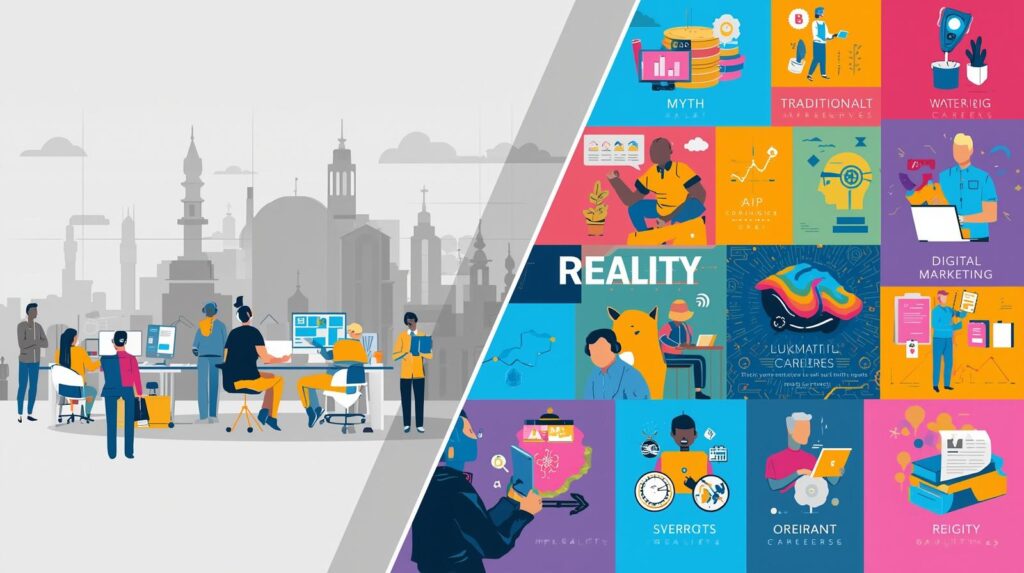
Today, careers in digital marketing, data science, design, entrepreneurship, and content creation are equally rewarding. Success depends more on skill, adaptability, and passion rather than just the title of the profession.
Reality: Success is defined by growth, satisfaction, and financial stability—not just traditional roles.

Your Child’s Future Is Bigger Than Just Two Options
2. High Marks Guarantee a Bright Future
Academic performance is important, but it is not the sole indicator of success. Many students who excel academically may struggle in real-world situations, while others with average grades may thrive due to creativity, communication skills, or problem-solving abilities.
Reality: Skills, mindset, and emotional intelligence play a bigger role than marks alone.
3. Arts and Humanities Have No Career Scope
A common misconception is that students choosing Arts or Humanities have limited career options. In reality, fields like psychology, media, law, public policy, and design offer diverse and lucrative opportunities.
Reality: Every stream—Science, Commerce, or Arts—has strong career prospects when approached strategically.
4. Government Jobs Are the Only Secure Option
Many parents still believe that government jobs provide unmatched job security and stability. While they do offer certain benefits, the private sector and entrepreneurial ventures now offer competitive salaries, flexibility, and rapid growth.
Reality: Job security today depends on continuous learning and adaptability rather than just job type.
5. Changing Career Paths Means Failure
Switching careers is often seen as a sign of instability. However, in the modern workforce, career shifts are quite common and often necessary for growth.
Professionals frequently upskill, reskill, or move into new domains to stay relevant.
Reality: Career changes reflect growth, self-awareness, and adaptability—not failure.
6. Passion Cannot Be a Career
Many parents encourage their children to keep passion separate from profession. While not every passion directly becomes a career, many modern professions are built around interests—such as photography, gaming, writing, or fitness.
Reality: With the right strategy and skills, passion can evolve into a sustainable career.
7. Traditional Careers Are Always Better Than New-Age Careers
Emerging fields like artificial intelligence, digital marketing, UX/UI design, and content creation are often viewed as unstable or temporary.
However, these industries are growing rapidly and offer global opportunities.
Reality: New-age careers are shaping the future and often provide better growth potential than traditional paths.
Why These Myths Persist
These beliefs often come from:
- Past experiences and limited exposure
- Fear of financial instability
- Lack of awareness about new industries
- Social pressure and comparison
While these concerns are valid, relying solely on outdated information can prevent students from reaching their full potential.
How Parents Can Support Better Career Choices
Parents play a crucial role in shaping a child’s future. Here’s how they can help:
1. Encourage Exploration
Allow children to explore different interests before making a decision.
2. Focus on Strengths
Understand your child’s natural abilities instead of comparing them with others.
3. Stay Updated
Learn about modern career options and industry trends.
4. Seek Professional Guidance
Career counselors can provide clarity through assessments and expert advice.
5. Promote Skill Development
Encourage learning beyond textbooks—communication, creativity, and digital skills matter.
Blog by Hanumanthrao